Wednesday, 10 December 2014

Review: Soldiers of Salamis

Title: Soldiers of Salamis (Solados de Salamina)
Author: Javier Cercas
Translator: Anne McLean
Genre: (Historical) Fiction
Year: 2001
Pages: 214

Soldiers of Salamis is a novel about an author, a fictionalized version of the novel's author Cercas, who does not know what to write about. He then stumbles upon the story of Rafael Sanchez Mazas, who was supposed to be executed by firing squad near the end of the civil war, but was able to run away. Wanting to find out how he was able to escape his death and how he spent the rest of his life, Cercas starts writing.

The novel is divided into three parts. The first one introduces Cercas as a journalist struggling to find his ambition. The second part tells the story of Mazas through the eyes of many of his acquaintances of the time of the Civil War. This part is supposedly the actual novel. Once this part is over, however, Cercas thinks the story incomplete. Here, we're thrown back into (fictional) Cercas's life, learning more about him, as well as Mazas and the Spanish Civil War.

While the premise of the story is intriguing, what struck me once I'd finished the novel, was that I enjoyed the first and last parts most, even though these are, in a sense, not the actual plot. This was mostly due to the structure and writing style of the middle part. As this existed of testimonies of men who may have misty memories as it was over 60 years ago, and then retold by Cercas, none of it was even remotely reliable. While many may think this is a strength of the novel and the way of story telling, it bothered me greatly. Moreover, it was told rather dryly. I would imagine Mazas's friends telling the stories with passion, grief even, but Cercas's report would then be really factual, summing up dates and events.
I was greatly pleased when I noticed the last part adapted a completely different style: the personal view of the start of the book came back and we get much more emotion as well as more engaged and beautiful writing. While I cared little for the main characters of the main storyline, Mazas and his friends, the characters in the last section truly touched my heart.

To conclude I would thus say that the novel was okay. Had it not been for the final part it would have hardly reached two stars, had it not been for the middle, I may have rated it four. Obviously, however, there would have been no story if it hadn't been for the middle part.



Monday, 8 December 2014

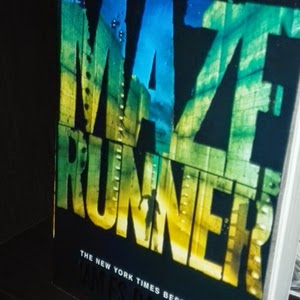
Review: The Maze Runner

Disclaimer: I read this novel quite a while ago. Therefore, this review will be a little bit short and simple because I took no notes etc.

Title: The Maze Runner
Author: James Dashner
Genre: YA Dystopian
Year: 2009
Pages:  374

When Thomas wakes up in the lift, he remembers nothing but his name. He is circled by boys he’s never seen before, and has no clue where he is. The boys gradually fill him in, and he finds out they all started out like this: waking up in a shaft, not remembering anything. He also learns where he is: in the middle of an enormous maze, which the boys have been trying to solve for years, and failed every time so far.

As seems to be the case with most young adult novels I’ve been reading recently, I thoroughly enjoyed the story, but the writing style did not grasp me. It took long before I got used to it, and therefore, it again took me forever to finish this novel. The author was quite repetitive, and I felt he could have used more synonyms for certain words, as well as refer to people with other words than their names.

Over all, I did like it, but am yet again not too eager to pick up the sequal. I will, eventually, but I am in no hurry.


Just over a week ago I also got the opportunity to watch the film, and I must say it was pretty good. It is, however, extremely different from the novel – even basic plot points have been radically changed. Consequently, I was on the edge of my seat, despite the fact that I had read the book.


Thursday, 4 December 2014

November Wrap Up! (a.k.a. reviews you may expect in the upcoming weeks)


Recently, I've mostly been reading books for uni classes. I've been taking one class on English South-African literature - reading Coetzee and Gordimer, and one class on European conflicts such as the Spanish Civil War and how these are represented in literature. The upcoming reviews will thus have to do with these novels. So let's go on to what I read in November!


Madame Bovary by Gustave Flaubert
This novel is about a woman, Emma, who after her marriage expects a great life, but this turns out to be an illusion. She tries reading to escape her boring life, but this doesn't work. Religion doesn't distract her either, and having a child turns out to only be a burden. I enjoyed this novel, but did not love it, so I rated it three out of five stars. 


Soldiers of Salamis by Javier Cercas
An author - a fictionalized Cercas - wants to write a novel, but is stuck on the subject. When he thinks about the story of Rafael Sánchez Mazas, who should have been executed by firing squad near the end of the Spanish Civil War but was able to escape, he decides to dive into this story. Another three out of five stars for me. 

In The Heart of the Country by J.M. Coetzee
Magda, the daughter of a white farmer in South-Africa, has grown up alone with her father and the servants at the farm. It's soon clear that Magda is delusional, and maybe even mad. Difficultly written and extremely conflusing at times, resulting in an only 2.5 star rating for this novel. 

The Sleeping Voice by Dulce Chacón
This novel is set right after the Spanish Civil War. It centers around Pepita who is a young woman, not at all interested in politics. However, she does get dragged into it as a messenger between her sister Hortensia who is imprisoned, and Hortensia's husband Filipe, who is a fugitive. While Pepita, I think, can be seen as the protagonist, we also learn a lot about the women in the prison with Hortensia. A heartbreaking story. 3.5 stars. 

Burger's Daughter by Nadine Gordimer
Rosa Burger's parents are very politically involved, being against the South-African apartheid regime. As a result, they are constantly in and out of prison. Her mother died when she was quite young, meaning she was to care for her father from quite a young age onwards. When he then dies, Rosa can for the first time focus on herself, establishing an identity for her own. The writing style of this novel is extremely confusing, and I did not have a pleasant reading experience, hence my two star rating. 

Lies of Silence by Brian Moore
Michael Dillon has finally decided to divorce his wife and go to London with his mistress. The night he wants to tell his  wife, however, they get in a fight and he decides to wait until the morning. That night, however, they're taken hostage by the IRA and their life is turned upside down. Although this was an enjoyable and thrilling story, the writing was not interesting and the characters were flat as well as stupid. I rated it 3 stars, but I may rate this down to 2.5. 


Stay tuned for reviews on all of these novels! 

Also, December has been pretty productive for me so far too, I've already read three books and will finish the fourth one today :)

Have a great Thursday! x

Wednesday, 3 December 2014

Review: Slaughterhouse-Five

Disclaimer: I read this novel, and the novels in the upcoming reviews, quite a while ago (mostly during the summer). Therefore, these reviews will be a little bit short and simple because I took no notes etc.

Title: Slaughterhouse-Five
Author: Kurt Vonnegut
Genre: War, Modern classic, Absurdist
Year: 1969
Pages: 215


Slaughterhouse-Five is an unconventional novel discussing the Second World War and consequential trauma. The narrator tells us the story of Billy Pilgrim, who, after having been abducted by aliens, gets unstuck in time.
         
I feel like it’s really been too long since I’ve read this novel to write a proper review. All I really wanted to say is that I was very intrigued by the story, and want to read it again and again. The writing style, the story, everything was equally interesting.

Once I reread this novel – hopefully within the next year – I will write a more elaborate and meaningful review. 


Tuesday, 2 December 2014

Review: The Fifth Wave

This is actually a review I wrote quite a while back, and forgot to publish. 


Title: The Fifth Wave
Author: Rick Yancey
Genre: YA Sci-fi
Year: 2013
Pages: 480
3.5 stars

“After the 1st wave, only darkness remains. After the 2nd, only the lucky escape. And after the 3rd, only the unlucky survive. After the 4th wave, only one rule applies: trust no one”


Our protagonist Cassie has survived these four waves. Not knowing what to expect from the next wave, all she does is running, trying to avoid contact with anybody – you never know for sure whether they’re even human. This distrust has kept her alive so far, but also meant being alone ever since she lost her family. But then the mysterious Evan Walker saves her life, and she has to choose between trusting him, or running away. However, she is weak, and she needs to rescue her brother. Evan may be her only chance to achieve this.

As you are probably aware, this novel has been extremely hyped up. That lead to me having high expectations. The beginning of this novel did live up to this, and I grew even more curious about the plot. However, it quickly became clear to me that Yancey’s writing style is not necessarily my cup of tea. It was too simple and there was too little depth to it. About half way through, I got stuck, even though the story was still quite intriguing.

While the writing was my main struggle, it was not the only. Without spoiling any of the story, I want to point out that I felt Cassie’s character was perhaps not the strongest. She is supposed to have survived quite horrific things, as well as having struggled alone for a while. However, after only a few moments of hesitation, she decides to trust Evan. I felt this was out of character, and it bothered me much more than it probably should have.

Over all, though, I did really enjoy it, and I’m very excited for the movie which will come out in the beginning of 2016. However, I am not running to the store to buy the sequel.


Wednesday, 26 November 2014

Review: Lord of the Flies

Disclaimer: I read this novel, and the novels in the upcoming reviews, quite a while ago (mostly during the summer). Therefore, these reviews will be a little bit short and simple because I took no notes etc.


Title: Lord of the Flies
Author: William Golding
Genre: Young adult / Classic
Year: 1954
Pages: 202


A plane crashes on an island. Only children survive. For them, this first appears a utopia: no adult supervision, Ultimate freedom. This changes quickly. Fights about who is to lead. The youngest children scared for a 'monster'. The perfect world collapses into a nightmare.
     While I was aware of the horrifying turn the novel would make later on, the beginning of the novel felt like an adventure story. Perhaps I had understood other people wrongly, maybe this was not such a haunting story. Obviously, I was too naive, and the tone of the story changed quickly.
     In the very beginning, already, there is the notion of power, of leadership. Who is to lead the group? Even when we've only been introduced to two characters, there is already a clear 'superior'. When more children come together, this battle becomes even more intense. Without authority, the children immediately decided some structure was needed, tasks also are divided. However, this results in multiple quarrels. Reading the novel critically, the novel never starts out as an excitin adventure, it's already a dramatic horror story to begin with.
    The structure they impose on themselves may delude the reader into thinking the children have it all together. Alright, there is a struggle on whom is to do what, but there's no real harm in that. Quickly, though, the children turn into savages, and the slight order they had is turned around. They split up into two camps who fight eachother brutally and this is when any reader will be disgusted and terrified.
     A few things bothered me about this novel, probably all related to the fact that it is a children's book. The writing style was, to me, uncompelling, and resulted in me having a hard time reading the novel quickly as I was unable to concentrate for too long. I cannot truly remember what it was about the style, but I feel like it is likely a result of Golding's eyed audience. This is also the case in terms of morals: they are too obvious which annoyed me.
    However, Golding makes up for this by writing no single sentence without allusions. Any sentence can be analysed, and on each page one can write a three thousand word essay. This is interesting and extremely entertaining, but only to a certain extend. I could not be bothered to actually look into each word in great depth, as that would slow down my reading so much, and honestly, I can only bring myself to doing that for some of my favourite novels, and this one is not one.
     I do feel everyone should have read it. It is a classic, and it is rightly so.

Monday, 24 November 2014

November Book Haul


I decided to make a little post about the few books I bought a while back in Amsterdam.


The Guernsey Literary and Potato Peel Pie Society - Mary Ann Shaffer & Annie Barrows
I must admit that this is a title buy. I don't know too much about it, other than that it's set in Guernsey and during the Second World War.

The Shock of the Fall - Nathan Filer
"I'll tell you what happened because it will be a good way to introduce my brother. His name's Simon. I think you're going to like him. I really do. But in a couple of pages he'll be dead. And he was never the same after that"
The blurb is really all I know about this one, and it sounds so intriguing to me. Also, a lot of people on booktube have been reading and loving it.

Unravel Me - Tahereh Mafi
This is the second book in the Shatter Me trilogy. I can't tell you too much about it without spoiling the first book, so if you care to know what the first book is about, check out my review.

Cinder - Marissa Meyer
This is the first one in a series of retellings of fairy tales. In this one, Cinder(ella) is a mechanic in New Beijing, but also a cyborg. When a disease is spreading, Cinder's life changes dramatically.

The Anglo-Saxon Chronicle
I actually did not buy this book in Amsterdam, but I thought I'd include it in here. This is basically a history of Anglo-Saxon times, written back then. Obviously, this has been translated. I've read a few entries in Old English back when I took a course on that, and I was excited  when I found this for a few Euros in an antique book store.